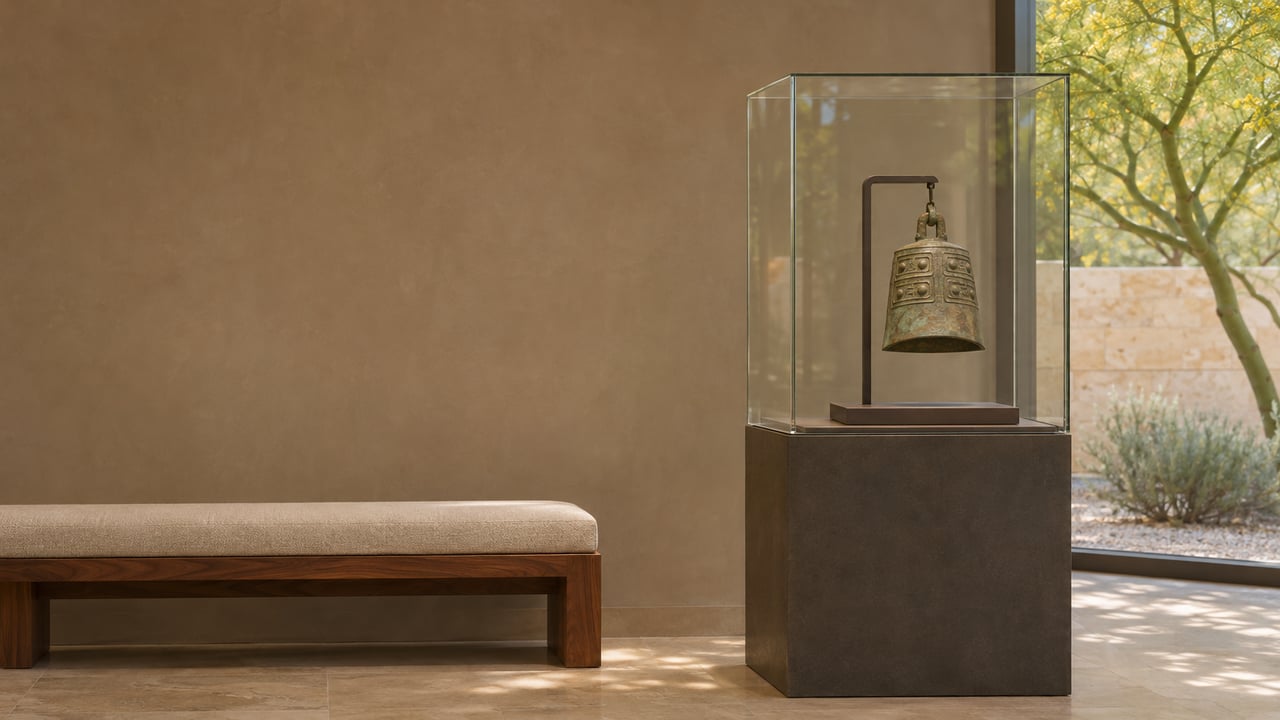
The largest bell in the Target Gallery at the Musical Instrument Museum belonged to Marquis Qiu of Zeng and was cast around 650 BCE. It has 188 legible characters running across its bronze body, along with interlaced dragon flanges and pairs of dragons in relief on its upper half. It is also the biggest bell in the largest known set of bells from China's Spring and Autumn period.
The bell is part of Unearthed Musical Masterpieces from the Southern Kingdoms of Ancient China, which opened at MIM on November 6 and runs through September 5, 2027. Visitors from out of town get one afternoon with it. People who live near Mayo Boulevard have ten months, and MIM has scheduled the exhibition's best extra, a curator-led tour, as a monthly event. You can see this show the way you'd read a long book, a few chapters at a time, starting this afternoon.
What came from Hubei
MIM organized the exhibition with the Hubei Provincial Museum, under the guidance of China's National Cultural Heritage Administration. It includes more than 70 ancient instruments and related objects. More than 40 of them are on view in the United States for the first time, and 10 are Grade One National Cultural Relics, China's highest designation for national treasures. Many came out of noble tombs. One of the exhibition's photographs shows bells still in place in a Zeng tomb at the Zaoshulin cemetery in Hubei Province.
Four regional museums lent pieces in addition to the Hubei Provincial Museum: Suizhou, Xiangyang, Changyang and Yichang. Sorted oldest to youngest, the featured highlights cover close to a thousand years of music:
- Animal-form bronze chime, c. 1300–1100 BCE, lent by Changyang Museum. At roughly 3,100 to 3,300 years old, it's the oldest piece on the featured list.
- Bo bell of Marquis Kang of Zeng, c. 1000 BCE, early Western Zhou, lent by Suizhou Museum. It's decorated with phoenix, cloud and animal-mask motifs, and its flattened flanges are shaped as pairs of tigers.
- Fanglei wine vessel of the Marquis of E, c. 1000–900 BCE, lent by Suizhou Museum. It's one of the ceremonial objects that show the world these instruments came from.
- Bo bell of Marquis Qiu of Zeng, c. 650 BCE, lent by Suizhou Museum. This is the 188-character bell described above.
- Yong bell of Marquis Yu of Zeng, c. 550–476 BCE, found in his tomb and lent by Suizhou Museum.
- "Order of the Qin King" bell, c. 550–450 BCE, from the late Spring and Autumn or early Warring States period, lent by Yichang Museum.
- Phoenix-pattern stone chime, 475–221 BCE, painted in the Chu style and lent by the Hubei Provincial Museum.
- Painted xuangu drum with phoenixes on tigers' backs, c. 400–300 BCE, a Chu instrument lent by Xiangyang Museum.
- Nao bell, c. 316 BCE, from a Chu noble's tomb and lent by the Hubei Provincial Museum.
Four of the nine highlights come from Suizhou Museum, and three of those carry the names of Zeng marquises. That makes the Zeng bells the core of the show. The Chu pieces, with their painted phoenixes and painted drum, are its color. The gallery also has ceramic and stone figures of musicians, armor and a helmet, a bronze sword, jade pendants, and excavation and performance video supplied by the Hubei Provincial Museum.
You can't play these bells; they are artifacts behind glass. If you want to make some noise, MIM's separate Experience Gallery is the place for hands-on playing.
A tour on the third Thursday
Today, Thursday, November 19, Eddie Chia-Hao Hsu, MIM's curator for Asia and Oceania, leads the first monthly highlights tour of the exhibition, from 2 to 2:30 p.m. The tour is included with special exhibition admission. You don't need a reservation, but space is limited and spots go first come, first served. MIM also notes that tours depend on the curator's availability.
Here's the published schedule through the end of the run:
| Month | Tour date | Time |
|---|---|---|
| November 2026 | Thursday, Nov. 19 | 2:00–2:30 p.m. |
| December 2026 | Thursday, Dec. 17 | 2:00–2:30 p.m. |
| January 2027 | Thursday, Jan. 21 | 2:00–2:30 p.m. |
| February 2027 | Thursday, Feb. 18 | 2:00–2:30 p.m. |
| March 2027 | Thursday, March 18 | 2:00–2:30 p.m. |
| April 2027 | Thursday, April 15 | 2:00–2:30 p.m. |
| May 2027 | Thursday, May 20 | 2:00–2:30 p.m. |
| June 2027 | Thursday, June 17 | 2:00–2:30 p.m. |
| July 2027 | Thursday, July 15 | 2:00–2:30 p.m. |
| August 2027 | Thursday, Aug. 19 | 2:00–2:30 p.m. |
A 30-minute tour can only reach the highlights, and MIM describes it as a complement to the self-guided visit rather than a replacement for it. That fits a split approach. Take your first pass on your own and spend real time with the inscriptions and the excavation footage. Then come back on a third Thursday and hear MIM's curator for Asia and Oceania explain what you were looking at. Hsu's opening-weekend talk focused on how archaeological finds in Hubei Province revealed one of the ancient world's most sophisticated musical traditions, and how those instruments still influence music today.
What a return visit costs
Exhibition tickets are sold separately from general admission. Current prices from MIM's visitor page:
- General admission: $24 for adults, $15 for teens 13–19, $10 for children 4–12, and free for children 3 and under. This is a one-day pass that doesn't include the special exhibition.
- Special exhibition: $7 for ages 20 and up, $4 for ages 4–19, and free for ages 3 and under, on top of general admission.
- Membership: starts at $100 a year and includes unlimited museum admission, free admission to monthly Signature Events, and a 10% discount on dining and shopping.
For one adult, a single visit with both tickets costs $31. Four general admissions add up to $96, so a $100 membership pays for itself on museum entry around the fourth visit, and a ten-month exhibition with ten tours gets a nearby household there quickly. Timing matters too. MIM uses timed-entry tickets through April 30, 2027, and Circle of Friends members can come any time without reserving. For a 2 p.m. tour you plan to fit into a workday afternoon, skipping the reservation is a practical advantage.
Getting there is simple. The museum is at 4725 E. Mayo Blvd., parking is free, and the lot entrance is on Mayo Boulevard just south of Loop 101.
Fitting it into the next six weeks
The exhibition is already linked to the rest of MIM's holiday calendar, so you can line up visits through December.
Saturday, November 21. "Echoes of the Southern Kingdoms: A Culinary Journey" is a five-course dinner from 5:30 to 7:30 p.m. that includes access to the Target Gallery. It costs $150 per person. It's the only listed chance to see the bells over dinner and outside daytime gallery hours.
Saturday and Sunday, December 5 and 6. MIM's seasonal Joy to the World event runs from 9 a.m. to 5 p.m. both days. Irish Christmas in America plays the MIM Music Theater at 5 p.m. on December 6. You can visit the Target Gallery in the morning and stay for the evening show without moving the car. We wrote more about using the theater as a neighborhood venue in our guide to MIM's summer season.
Thursday, December 17. The second curator tour is at 2 p.m. If you've hosted relatives over the holidays and want something to do with them, a guided half hour among 2,700-year-old bronze is a good choice.
Christmas Day. MIM is open from 10 a.m. to 5 p.m.
The opening weekend, November 6 through 8, featured lion dances, pop-up performances on Chinese flutes and zither, and a craft where visitors made their own versions of bianzhong bell sets. The Valley Now covered it on November 7. That weekend has passed, but the gallery and the monthly tours continue for ten more months. For more of what's happening around the museum's end of Mayo, see our Desert Ridge neighborhood page.
Knowing which galleries are worth a second visit, and which afternoons work for it, is part of the neighborhood knowledge we bring to every client. If a move to Desert Ridge would put MIM within an easy drive, ARC° Partners can show you what living near Mayo Boulevard looks like. Make a Move.